

Introduction
For decades, engineering has been one of the most preferred career choices in India. Thousands of students aspired to become engineers, leading to the rapid establishment of engineering colleges across the country. However, over the past decade, the landscape has changed dramatically. Every year, several engineering colleges either shut down, merge with other institutions, or stop admitting new students.
This trend often raises an important question: Why are engineering colleges closing in India?
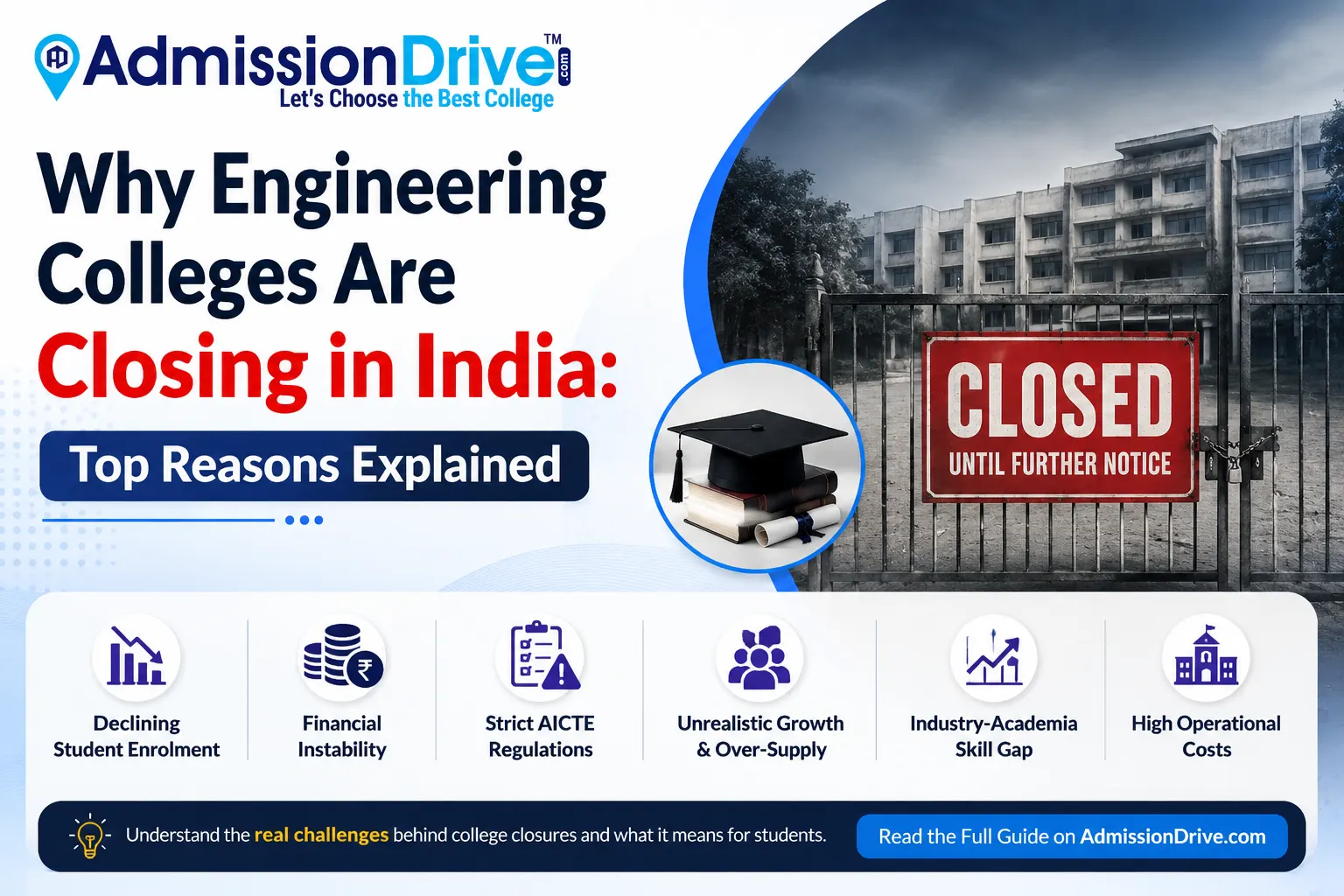
The answer is not limited to a single reason. Instead, it is the result of changing student preferences, employment trends, demographic shifts, educational quality concerns, and stricter regulatory standards. This article explains the key reasons behind the closure of engineering colleges in India using factual and balanced information.
Highlights
The trend of engineering college closures has continued into the 2025–26 academic session. Based on information released by the All India Council for Technical Education (AICTE), around 58 engineering and technical institutions across India entered the process of progressive closure. Under this process, colleges stop admitting new students while ensuring that existing students can complete their academic programmes. The decision is generally linked to factors such as consistently low admissions, financial sustainability issues, difficulty in meeting regulatory requirements, and maintaining adequate faculty and infrastructure. This reflects a broader shift in India’s technical education sector, where greater emphasis is being placed on improving educational quality and long-term institutional viability rather than increasing the number of colleges.
1. Declining Student Demand
One of the biggest reasons engineering colleges are closing is the steady decline in student admissions.
During the early 2000s, engineering education experienced massive growth due to increasing demand for software professionals and expanding IT companies. To meet this demand, hundreds of private engineering colleges were established across different states.
Today, the situation is different.
Many students are exploring alternative career options such as:
- Management
- Data Science
- Artificial Intelligence
- Design
- Law
- Commerce
- Healthcare
- Digital Marketing
- Entrepreneurship
- Government jobs
As career opportunities become more diverse, fewer students choose traditional engineering courses, resulting in vacant seats in many institutions.
2. Oversupply of Engineering Colleges
India witnessed an unprecedented expansion of engineering institutions between 2005 and 2015.
In several states, colleges were established faster than the actual demand for engineering education. While this increased access to technical education, it also created an oversupply of seats.
Many colleges now struggle to fill even half of their available seats. When admissions remain consistently low, maintaining infrastructure, faculty salaries, laboratories, and administrative costs becomes financially unsustainable.
As a result, some institutions voluntarily discontinue operations or surrender their approval to regulatory authorities.
3. Employability Concerns
A degree alone is no longer sufficient in today’s competitive job market.
Many employers seek graduates who possess:
- Practical technical knowledge
- Programming skills
- Communication abilities
- Problem-solving skills
- Internship experience
- Industry exposure
Unfortunately, some engineering colleges have been criticized for emphasizing theoretical learning while offering limited practical training or industry interaction.
Students are increasingly evaluating colleges based on placement records, faculty quality, industry collaborations, and internship opportunities. Institutions that consistently underperform in these areas often experience declining admissions.
4. Rising Preference for Skill-Based Learning
The technology industry is changing rapidly.
Many employers now value practical skills alongside formal qualifications. Students are increasingly enrolling in:
- Professional certifications
- Online learning platforms
- Coding bootcamps
- Industry certification programs
- Short-term technical courses
These learning options are often more affordable, flexible, and aligned with current industry needs.
As a result, some students prefer combining a degree with specialized skill development, while others prioritize alternative educational pathways, reducing demand for certain engineering programs.
5. High Operational Costs
Running an engineering college requires significant financial investment.
Institutions must maintain:
- Modern laboratories
- Workshops
- Libraries
- Campus infrastructure
- Computer facilities
- Faculty salaries
- Student support services
- Accreditation requirements
When admissions decline, fee income also decreases. Without sufficient revenue, many colleges face financial challenges that make long-term operations difficult.
6. Stricter Regulatory and Quality Standards
Regulatory authorities have strengthened quality standards for technical education over the years.
Engineering institutions are expected to maintain:
- Qualified faculty members
- Adequate infrastructure
- Laboratory facilities
- Student-faculty ratios
- Academic governance
- Safety standards
- Continuous quality improvement
Colleges that fail to meet prescribed norms may face restrictions on admissions or choose to discontinue operations if compliance becomes financially or administratively challenging.
These measures are intended to improve the overall quality of technical education.
7. Changing Industry Requirements
Engineering education must continuously evolve alongside technological advancements.
Industries now seek expertise in areas such as:
- Artificial Intelligence
- Machine Learning
- Robotics
- Cybersecurity
- Cloud Computing
- Internet of Things (IoT)
- Data Analytics
- Semiconductor technologies
Some institutions have updated their curriculum and infrastructure to match these developments. Others have struggled to modernize due to limited resources.
Students increasingly prefer colleges that offer contemporary programs with strong industry partnerships.
8. Demographic and Regional Factors
Population trends and regional differences also influence admissions.
Certain regions have witnessed:
- Reduced demand for local engineering colleges
- Migration of students to metropolitan cities
- Preference for nationally reputed institutions
- Increased competition among nearby colleges
In districts where multiple engineering colleges operate within a limited geographical area, only institutions with stronger reputations and better placement outcomes tend to attract sufficient student enrolment.
9. Better Awareness Among Students
Today’s students and parents have access to more information than ever before about top engineering colleges.
They carefully evaluate factors such as:
- Accreditation status
- Placement statistics
- Faculty qualifications
- Infrastructure
- Student reviews
- Industry partnerships
- Return on investment
This increased awareness encourages students to choose institutions with stronger academic records rather than selecting colleges solely based on seat availability.
As a result, colleges with weaker performance often experience falling admissions.
10. Economic Sustainability Challenges
Private engineering colleges primarily depend on tuition fees for operational expenses.
When seat occupancy remains consistently low over several years, institutions may face:
- Revenue shortages
- Difficulty retaining experienced faculty
- Delayed infrastructure upgrades
- Reduced investment in laboratories
- Financial losses
In such situations, management may decide that continuing operations is no longer economically viable.
Are Engineering Colleges Closing Across the Entire Country?
No.
While many institutions have closed or reduced admissions, numerous engineering colleges continue to perform exceptionally well.
Leading institutions with strong academic standards, research facilities, industry collaborations, and placement records continue to attract large numbers of applicants every year.
The demand remains particularly strong for colleges that provide quality education, updated curricula, experienced faculty, and strong career support.
What Does This Mean for Future Engineering Students?
The closure of some engineering colleges does not mean engineering has lost its value. Instead, it reflects a shift toward quality over quantity.
Students should focus on selecting institutions that offer:
- Recognized accreditation
- Experienced faculty
- Modern curriculum
- Strong laboratory facilities
- Internship opportunities
- Good placement support
- Industry collaborations
- Opportunities for innovation and research
Choosing a college for B.Tech Admission based on educational quality rather than proximity or low fees can contribute significantly to long-term career development.
Conclusion
The closure of engineering colleges in India is the result of multiple interconnected factors rather than a single cause. Declining admissions, an oversupply of institutions, changing career preferences, employability expectations, financial pressures, and evolving industry demands have collectively reshaped the engineering education landscape.
At the same time, this transition is encouraging institutions to improve academic quality, modernize curricula, strengthen industry partnerships, and focus more on student outcomes. For aspiring engineers, the key takeaway is clear: success depends not only on earning an engineering degree but also on choosing a quality institution and continuously developing relevant skills throughout one’s career.
Disclaimer: The information presented in this article is published based on research from publicly available sources, official reports, and industry trends available at the time of writing. While every effort has been made to ensure the accuracy and reliability of the content, educational policies, institutional status, and regulatory information may change over time. Readers are advised to verify important information through official sources, such as the relevant educational institutions, regulatory authorities, and other reliable platforms, before making any academic or career-related decisions. This article is intended for general informational purposes only and should not be considered professional, legal, or educational advice.

