

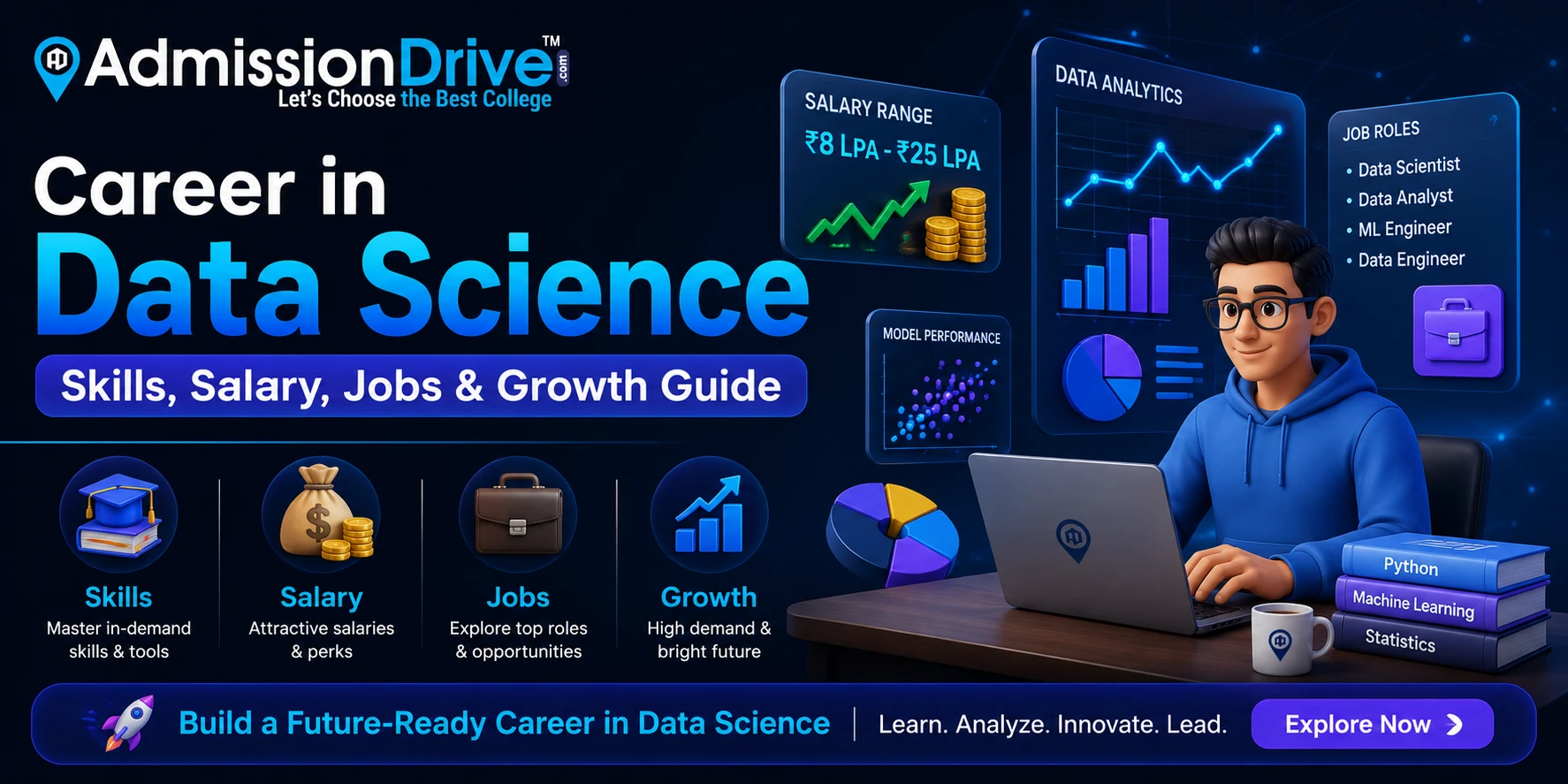
Career in Data Science — Skills, Salary, Jobs & Growth Guide
A grounded look at what it actually takes to build a Data Science career in 2026 — the skills worth prioritizing, what the job market pays across India, the US, and Europe, which roles suit beginners, and a realistic path to your first offer.
Type "should I learn data science" into any search engine and you'll get a flood of confident opinions in both directions. The honest answer sits in the middle: the field hasn't slowed down, but the way in has changed. Five years ago, a certificate and a basic understanding of Python could get you an interview. In 2026, hiring managers filter for people who've actually wrangled messy data and can explain a decision they made, not just list tools on a resume.
This guide skips the hype and focuses on what tends to actually move the needle — which skills to prioritize first, what realistic pay looks like at each career stage, and how to structure your learning so you're not just collecting course completions.
1. What Does a Data Scientist Actually Do?
Strip away the job title and the work comes down to a repeatable cycle: get hold of data that's usually incomplete or messy, clean it up, look for patterns worth acting on, build a model or analysis that captures those patterns, and then explain the result to someone who has to make a decision based on it. The "science" part is really just disciplined curiosity backed by statistics and code.
A hospital trying to anticipate bed shortages, a retailer deciding which products to restock, a bank flagging suspicious transactions — all of these lean on the same underlying skillset, applied to different data and different stakes.
2. Why Data Science Still Makes Sense in 2026
The case for the field hasn't really changed — it's just gotten more specific. A few things stand out this year:
- Every industry generates more data than it did last year. Retail, healthcare, logistics, agriculture — sectors that barely touched analytics a decade ago now run entire teams around it.
- AI adoption has shifted the role, not eliminated it. Generative AI tools handle a lot of boilerplate code and first-draft analysis, which means the human value has moved toward framing the right question and judging whether a model's output is actually trustworthy.
- Pay has held up at the mid-to-senior level even as entry-level hiring has tightened, which rewards people who build a body of real project work early.
- Remote and hybrid data roles are common, so geography matters less than it used to for landing a good position.
3. Skills You Genuinely Need
You don't need to master everything on this list before applying anywhere. Employers hire for a working combination of these, not a perfect score on each one.
Coding — Python and SQL first
Python remains the default language because of its libraries — pandas and NumPy for handling data, scikit-learn for classical machine learning, and PyTorch or TensorFlow once you move into deep learning. SQL is non-negotiable: almost every dataset you'll touch on the job lives in a database, and being slow at SQL slows down everything downstream. R still has a place in academic and biostatistics-heavy roles, but it's no longer the default recommendation for beginners.
Statistics that you can actually apply
You don't need a PhD-level grasp of theory, but you do need to be comfortable with distributions, hypothesis testing, correlation versus causation, and regression. These are the concepts that stop you from mistaking noise for a real pattern — a mistake that's easy to make with modern tools that will happily fit a model to anything you feed them.
Data wrangling and exploratory analysis
In practice, most of the job is cleaning data, not modeling it. Missing values, duplicate records, inconsistent formatting, and outliers eat up far more time than people expect going in. Getting fast and comfortable at this stage pays off more than obsessing over the newest algorithm.
Machine learning — know when, not just how
Understanding when a decision tree beats a linear model, or when clustering makes sense over classification, matters more early on than memorizing the math behind every algorithm. Deep learning, NLP, and computer vision are worth layering in once the fundamentals are solid.
Communicating results
A technically sound model that nobody can act on is a wasted effort. Being able to build a clear chart, write a short summary a non-technical manager can follow, and defend your assumptions in a meeting is often what separates people who get promoted from people who don't.
| Skill Area | Priority for Beginners | Common Tools |
|---|---|---|
| Python programming | Essential — start here | pandas, NumPy, Jupyter |
| SQL | Essential — start here | PostgreSQL, MySQL |
| Statistics | Essential | — |
| Data visualization | Essential | Matplotlib, Seaborn, Power BI, Tableau |
| Machine learning | Intermediate stage | scikit-learn |
| Cloud platforms | Intermediate stage | AWS, Azure, GCP |
| Deep learning | Advanced stage | PyTorch, TensorFlow |
| Big data tools | Advanced / role-specific | Spark, Hadoop |
4. Do You Need a Specific Degree?
No, though your starting point does affect how much self-directed learning you'll need. A computer science, statistics, or engineering degree gives you a head start on programming and math fundamentals. Coming from economics, physics, or the life sciences works too, since those fields already train you in quantitative reasoning — you'll just need to invest more deliberately in coding.
What consistently matters more than the degree name is evidence of applied work: a GitHub profile with real projects, a couple of Kaggle competitions attempted seriously, or a portfolio that shows you can take a messy dataset from raw file to finished analysis. Hiring managers screening entry-level candidates say this more often than almost anything else.
5. Are Certifications Worth It?
Certifications won't get you hired on their own, but they're useful for structuring your learning if you're prone to wandering between tutorials without finishing anything. Programs from major cloud providers (AWS, Azure, Google Cloud) carry more weight than generic "data science" certificates because they verify a specific, checkable skill. Treat any certificate as a byproduct of doing real project work, not a substitute for it.
6. A Realistic Learning Roadmap
- Python fundamentals (4–6 weeks): variables, control flow, functions, and enough object-oriented programming to read other people's code.
- SQL (2–3 weeks): joins, aggregations, subqueries — practice on real, messy public datasets rather than toy examples.
- Statistics (4–6 weeks): descriptive stats, probability, hypothesis testing, and regression, ideally applied alongside a dataset rather than in the abstract.
- Data wrangling and visualization (4 weeks): pandas for cleaning, Matplotlib/Seaborn or a BI tool for communicating findings.
- Machine learning fundamentals (8–10 weeks): supervised learning first, then a light introduction to unsupervised methods.
- Build 3–5 end-to-end projects: pick problems you find genuinely interesting — a well-documented project you care about beats a generic tutorial clone every time.
- Apply broadly and iterate: use early interview feedback to identify real gaps rather than guessing what to study next.
Most people moving from zero coding background land their first offer somewhere between month nine and month fourteen of consistent effort. That timeline compresses if you already code or already know statistics.
7. Job Roles and Where to Start
Data Analyst
Best entry point. Focused on querying, reporting, and dashboards rather than modeling.
Junior Data Scientist
Blends analysis with early modeling work, usually under closer supervision.
Machine Learning Engineer
Leans more toward software engineering — deploying and maintaining models in production.
Data Engineer
Builds the pipelines that get data to analysts and scientists in usable shape.
Business Intelligence Analyst
Reporting-heavy, closer to business stakeholders than to model-building.
AI Engineer
Applies pre-trained and custom models to build AI-powered features and products.
Most people don't land in a "Data Scientist" title straight away, and that's fine — a year or two as a Data Analyst or BI Analyst is a common, sensible on-ramp that builds exactly the skills a Data Scientist role expects.
8. Salary Guide — India, US, Europe
Figures below are broad market ranges, not guarantees — actual pay depends heavily on company type, city, and how well you can demonstrate applied skill in an interview.
India — by experience
| Experience | Typical Annual Salary |
|---|---|
| Fresher (0–1 yr) | ₹5 – ₹9 LPA |
| Junior (1–3 yrs) | ₹8 – ₹14 LPA |
| Mid-level (3–5 yrs) | ₹14 – ₹24 LPA |
| Senior (5–8 yrs) | ₹24 – ₹38 LPA |
| Lead / Principal (8+ yrs) | ₹38 – ₹65+ LPA |
United States — by experience
| Experience | Typical Annual Salary (USD) |
|---|---|
| Entry-level | $90,000 – $120,000 |
| Mid-level | $120,000 – $160,000 |
| Senior | $160,000 – $210,000+ |
| Principal / Staff | $210,000 – $290,000+ |
Selected Europe (annual)
| Country | Typical Range |
|---|---|
| Germany | €58,000 – €92,000 |
| Netherlands | €52,000 – €85,000 |
| United Kingdom | £48,000 – £85,000 |
| Switzerland | CHF 105,000 – 155,000+ |
9. Who's Actually Hiring
Data roles aren't confined to tech companies anymore. The strongest current demand sits in banking and financial services (fraud detection, credit risk), healthcare (diagnostics support, hospital operations), e-commerce and retail (demand forecasting, personalization), and telecom (churn prediction, network optimization). Manufacturing, logistics, energy, and the public sector are earlier in their adoption curve but growing steadily, which can mean less competition for candidates willing to specialize there.
10. Frequently Asked Questions
Ready to Start Building Your Data Science Skills?
Pick one dataset today and start cleaning it in Python. Momentum from a real project beats another unfinished course every time.
Note: ⚠️ Salary figures are indicative market ranges and vary by company, city, and individual negotiation. The content is based on research. We recommend verifying the information on official websites, as we do not guarantee 100% accuracy.