

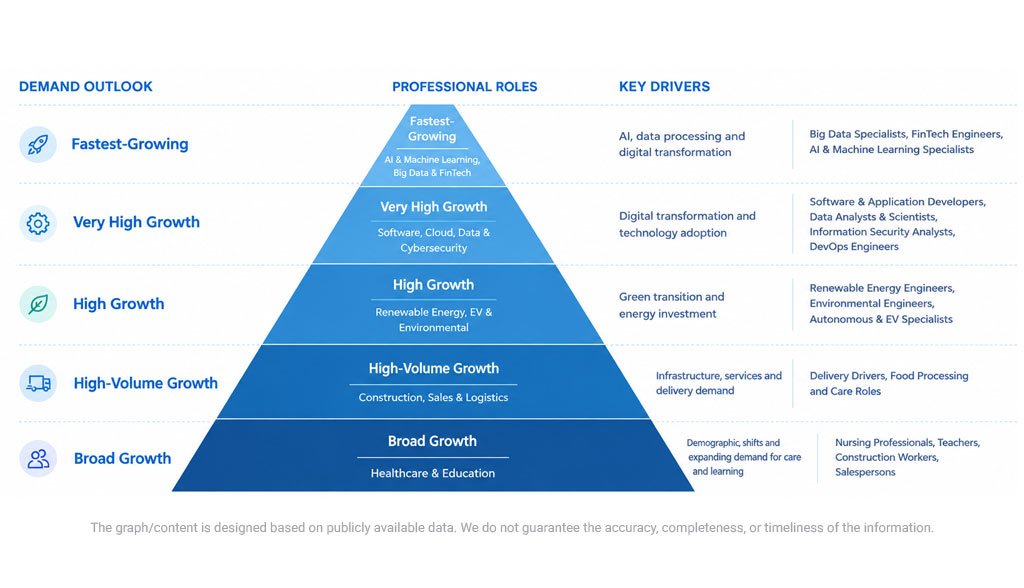
The world of work is changing faster than ever. New technologies, changing customer expectations, digital transformation, and global challenges are creating new career opportunities while reshaping traditional jobs. As businesses adapt, they need professionals who can combine technical knowledge with creativity, problem-solving, communication, and adaptability.
If you are planning your career or considering a professional change, understanding which professionals will be in demand in the future can help you make a more informed decision. From artificial intelligence and cybersecurity to healthcare and renewable energy, several fields are expected to offer strong opportunities in the years ahead.
Why Future Career Trends Matter
Choosing a career is not only about finding a job today. It is also about developing skills that remain valuable as industries evolve.
Automation and artificial intelligence are taking over many repetitive tasks, but they are also creating demand for people who can manage technology, analyze information, develop innovative solutions, and make thoughtful decisions. At the same time, industries such as healthcare, education, sustainability, and technology continue to require skilled professionals.
The key is to focus on careers where human expertise and technology work together.
Top Professionals in Demand for the Future
1. Artificial Intelligence and Machine Learning Professionals
Artificial intelligence is becoming part of everyday business operations, from customer service and marketing to healthcare and finance. As organizations look for practical ways to use AI, professionals with expertise in machine learning, AI development, automation, and intelligent systems are likely to remain highly valuable. If your dream is to be a successful AI engineer in future the AI engineering course would be the best for you, you may check top B.Tech CSE AI Colleges for the admission.
AI professionals may work on developing models, improving automated systems, analyzing data, or creating AI-powered products.
Useful skills include:
- Machine learning
- Programming
- Data analysis
- Natural language processing
- Problem-solving
- AI ethics and responsible technology
2. Data Scientists and Data Analysts
Businesses generate enormous amounts of information every day. However, data only becomes useful when skilled professionals can interpret it and turn it into meaningful insights.
Data scientists and analysts help organizations identify patterns, understand customer behavior, measure performance, and support better decision-making. Their work can influence everything from product development to business strategy.
A strong understanding of statistics, data visualization, databases, and analytical tools can create valuable career opportunities in this field.
3. Cybersecurity Professionals
As more businesses move their operations online, protecting digital systems has become a major priority. Cyberattacks, data breaches, identity theft, and other security threats can create serious financial and reputational damage.
Cybersecurity professionals help organizations identify vulnerabilities, protect networks, monitor systems, and respond to security incidents.
Potential career paths include:
- Cybersecurity analyst
- Security engineer
- Ethical hacker
- Security consultant
- Cloud security specialist
For people who enjoy technology, investigation, and problem-solving, cybersecurity can be a promising career direction.
4. Software Developers and Engineers
Software continues to power websites, mobile applications, business platforms, financial services, healthcare systems, and countless other products.
While development tools are becoming more automated, organizations still need skilled professionals who understand how to design, build, test, maintain, and improve software.
Professionals who combine programming knowledge with an understanding of AI, cloud computing, automation, or cybersecurity may have an additional advantage in the evolving technology job market.
5. Cloud Computing Professionals
Companies increasingly rely on cloud platforms to store information, run applications, scale services, and support remote operations. This has increased the need for professionals who understand cloud infrastructure and services.
Cloud-related roles can include cloud engineers, cloud architects, DevOps professionals, and cloud security specialists.
Knowledge of cloud platforms, networking, automation, and security can help professionals build long-term careers in this area.
6. Healthcare Professionals
Healthcare will continue to need skilled professionals as populations grow older, healthcare technology advances, and demand for medical and support services increases.
Doctors, nurses, therapists, medical technologists, healthcare administrators, and other specialists all play important roles in the healthcare ecosystem.
Technology is also changing healthcare through telemedicine, digital health platforms, medical devices, and data-driven treatment. This means professionals who understand both healthcare and technology may find new opportunities emerging.
7. Renewable Energy Professionals
The transition toward cleaner energy is creating demand for professionals who can support renewable power generation, energy efficiency, electric mobility, and sustainable infrastructure.
Engineers, environmental specialists, energy consultants, project managers, and sustainability professionals can contribute to this growing sector.
People interested in solving environmental challenges while building a technical career may find renewable energy particularly attractive.
8. Robotics and Automation Specialists
Robots and automated systems are increasingly being used in manufacturing, logistics, healthcare, agriculture, and other industries.
As automation expands, companies need professionals who can design, program, operate, maintain, and improve these systems.
Careers in robotics can combine mechanical engineering, electronics, programming, artificial intelligence, and systems design.
9. Digital Marketing Professionals
Businesses need more than traditional advertising to reach modern consumers. Search engines, social media, email, content platforms, and online communities have become important parts of the customer journey.
Digital marketing professionals help brands reach the right audiences and measure the effectiveness of their campaigns.
Skills in SEO, content marketing, analytics, social media, paid advertising, and marketing automation can be useful for building a career in this field.
10. UX and Product Design Professionals
Technology may be powerful, but it still needs to be easy and enjoyable for people to use. UX designers and product designers focus on understanding users and creating products that solve real problems.
As businesses compete on digital experiences, professionals who can combine research, design thinking, creativity, and technology are likely to remain important.
11. Mental Health Professionals
Mental health has become an increasingly important part of overall well-being. As awareness grows, demand for qualified psychologists, counselors, therapists, and other mental health professionals is expected to remain significant.
This career path requires strong interpersonal skills, empathy, professional training, and a genuine interest in helping people.
12. Sustainability and Environmental Professionals
Organizations across industries are paying greater attention to environmental impact, resource efficiency, responsible operations, and sustainability.
Environmental scientists, sustainability managers, ESG professionals, and related specialists can help businesses develop more responsible strategies and practices.
This field can be particularly suitable for professionals who want their careers to contribute to environmental and social goals.
Skills That Can Help You Stay Career-Ready
Knowing which jobs are growing is useful, but job titles alone do not guarantee long-term success. The ability to learn and adapt can be just as important.
Some valuable future-ready skills include:
- Digital literacy: Understanding modern digital tools and platforms.
- AI awareness: Knowing how artificial intelligence can be used responsibly in your profession.
- Analytical thinking: Being able to evaluate information and make logical decisions.
- Communication: Explaining ideas clearly to colleagues, clients, and customers.
- Creativity: Finding new approaches to problems and opportunities.
- Adaptability: Being comfortable learning new tools and working methods.
- Collaboration: Working effectively with people from different backgrounds and specialties.
- Continuous learning: Updating your knowledge as your industry changes.
How to Prepare for the Future Job Market
You do not necessarily need to completely change your career to stay relevant. In many cases, adding new skills to your existing expertise can create better opportunities.
For example, a marketer can learn data analytics and AI-powered marketing tools. A software developer can develop cybersecurity or cloud skills. A healthcare professional can become familiar with digital health technologies.
A practical approach is to:
- Identify where your industry is heading.
- Research the skills employers are increasingly seeking.
- Choose one or two skills that complement your existing expertise.
- Build practical experience through projects, courses, or work assignments.
- Keep updating your knowledge instead of relying only on past qualifications.
The Future of Work Is About More Than Technology
Technology will undoubtedly influence the future job market, but not every successful career will be purely technical. Human qualities such as empathy, leadership, creativity, communication, judgment, and relationship-building remain difficult to replace.
The strongest professionals may be those who know how to work with technology rather than compete against it. Someone who combines industry knowledge with digital skills can often bring a valuable perspective to an organization.
Final Thoughts
The future job market will continue to evolve, creating both challenges and opportunities for professionals. Careers in artificial intelligence, data, cybersecurity, software development, healthcare, renewable energy, robotics, digital marketing, design, and sustainability are among the areas attracting growing attention.
However, there is no single career that guarantees success. The most reliable strategy is to develop relevant expertise, stay curious, and continuously improve your skills.
Whether you are a student choosing your first career, a professional planning your next move, or someone considering a career change, paying attention to future career trends can help you prepare for a changing world of work.

