

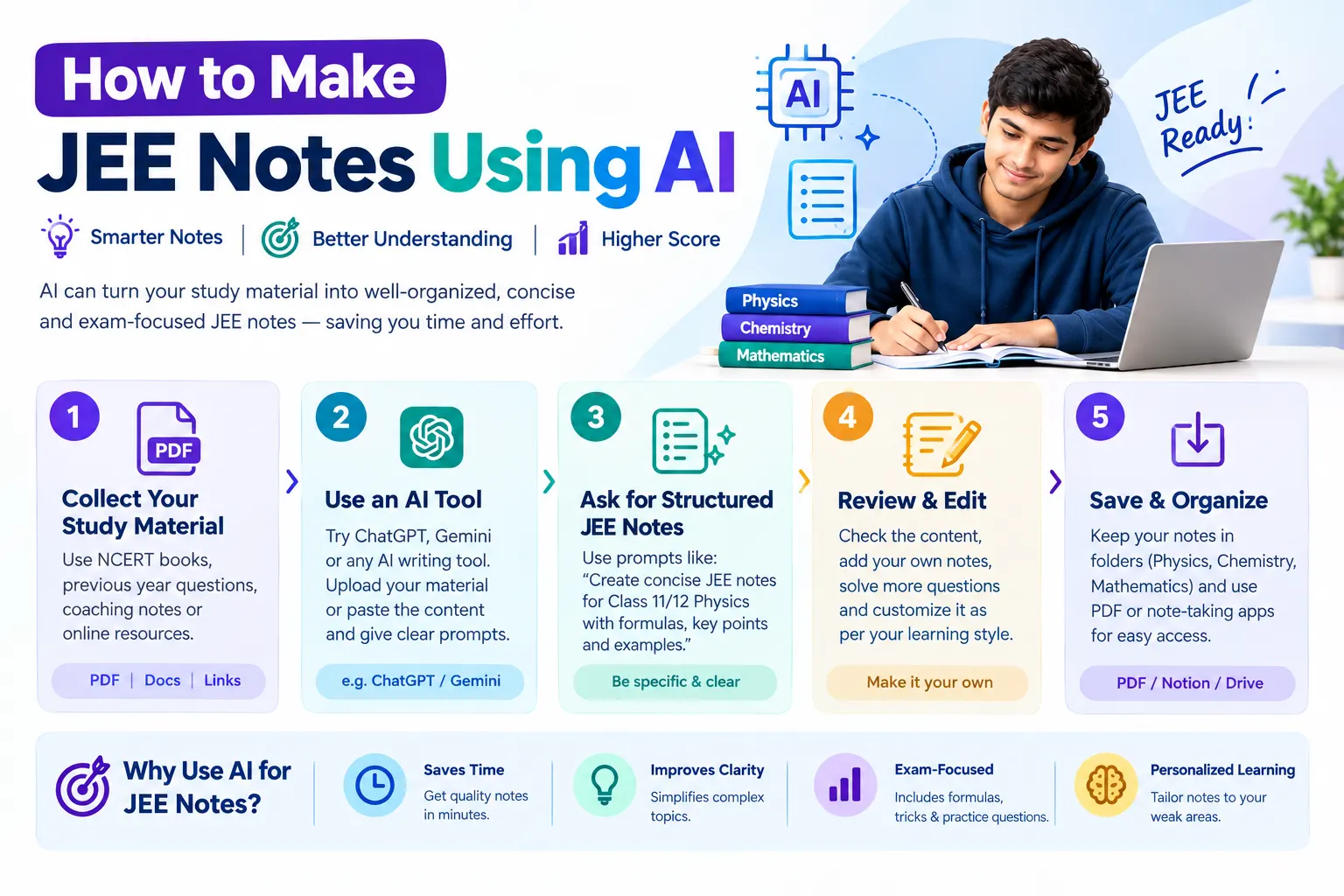
The JEE Main 2027 is India’s leading entrance exam, preparing for the JEE (Joint Entrance Examination) requires more than simply reading textbooks and solving questions. Good notes can help you revise important concepts quickly, identify weak areas, and remember formulas for longer.
With the right approach, AI tools can help JEE aspirants create, organize, and improve their study notes. However, AI should be used as a study assistant—not as a replacement for textbooks, teachers, or your own problem-solving practice.
In this guide, you’ll learn how to make JEE notes using AI, how to create subject-wise notes, useful AI prompts, and mistakes to avoid.
Why Use AI for JEE Notes?
JEE preparation involves managing a vast amount of information across Physics, Chemistry, and Mathematics. Creating and maintaining notes manually can be time-consuming, making it challenging for students to focus on effective preparation. A well-organized approach to learning and revision can help students prepare efficiently for entrance exams and pursue opportunities for B.Arch/B.Tech admissions.
AI can help you:
- Summarize lengthy study material into revision points.
- Organize concepts chapter by chapter.
- Extract important formulas and definitions.
- Create flashcards for revision.
- Generate practice questions.
- Explain difficult concepts in simpler language.
- Identify connections between related concepts.
- Turn your existing notes into quick revision sheets.
The important point is to verify AI-generated information against your NCERT textbook, standard JEE books, classroom notes, and reliable educational resources.
How to Make JEE Notes Using AI
1. Start With Your JEE Syllabus
Before asking an AI tool to create notes, give it a clear topic or chapter.
For example, instead of asking:
“Make JEE Physics notes.”
Use a specific request such as:
“Create concise revision notes for the JEE Physics chapter Rotational Motion. Include important concepts, formulas, common mistakes, and the conditions under which each formula can be used.”
A specific prompt generally produces more useful notes because the AI has a clear task.
2. Use AI to Create a Chapter Summary
After studying a chapter from your textbook or class material, you can ask AI to help organize what you learned.
For example:
Prompt:
“Create a concise revision summary of [chapter name] for JEE preparation. Organize it into key concepts, important formulas, definitions, common mistakes, and concepts that require numerical practice. Do not introduce information outside the JEE syllabus.”
You can then compare the result with your study material and correct anything that is incomplete or inaccurate.
3. Create Formula Sheets With AI
Formula revision is particularly useful for JEE Physics and Mathematics.
Ask AI to organize formulas in a structured format:
Prompt:
“Create a JEE revision sheet for [chapter]. List the important formulas, define every variable, mention the conditions where each formula applies, and provide one short example for difficult formulas.”
Don’t blindly memorize the generated list. Understanding when and why a formula works is more important than simply remembering it.
Using AI to Make JEE Physics Notes
Physics notes should focus on concepts, formulas, assumptions, graphs, and problem-solving approaches.
For example, your AI-assisted notes for a chapter can contain:
- Important laws and principles
- Formula list
- Meaning of variables
- Units and dimensions
- Important graphs
- Special cases
- Common traps
- Typical question approaches
Example AI Prompt for Physics
“Help me create JEE Physics revision notes for Work, Energy and Power. Divide the notes into concepts, important equations, special cases, graphs, common mistakes, and question-solving approaches. Keep the explanations concise and suitable for quick revision.”
After generating the notes, solve several JEE-level problems yourself. If you cannot apply a concept to a problem, your notes probably need a clearer explanation.
Using AI to Make JEE Chemistry Notes
Chemistry requires a slightly different note-making strategy because Physical, Organic, and Inorganic Chemistry involve different types of learning.
Physical Chemistry
Ask AI to organize:
- Important equations
- Definitions
- Units
- Conditions
- Graphs
- Common numerical approaches
Organic Chemistry
Your notes can include:
- Important reactions
- Reagents
- Reaction conditions
- Mechanisms
- Named reactions
- Conversion patterns
- Exceptions
Inorganic Chemistry
Focus on:
- Important properties
- Trends
- Reactions
- Exceptions
- Comparisons
- Important facts from NCERT
Example Chemistry Prompt
“Create revision notes for JEE Chemistry on [chapter]. Separate the content into key concepts, reactions, formulas, exceptions, important trends, and common mistakes. Keep the notes concise and prioritize information relevant to JEE preparation.”
For Chemistry, always cross-check important factual information with your prescribed study material.
Using AI to Make JEE Mathematics Notes
Mathematics notes should not become a collection of formulas. They should help you understand which method to use for a particular type of problem.
For each topic, consider creating sections for:
- Important formulas
- Definitions
- Standard results
- Problem-solving methods
- Special cases
- Common mistakes
- Question patterns
For example:
Prompt:
“Create JEE Mathematics revision notes for Permutations and Combinations. Include important formulas, explain when each formula should be used, list common mistakes, and provide representative problem types without solving every problem.”
This approach can make your notes more useful during revision.
Turn Your Notes Into Flashcards
One useful application of AI is converting long notes into short question-and-answer flashcards.
For example:
Question: What is the relation between angular velocity and linear velocity?
Answer: For circular motion, linear speed is related to angular speed through v=rωv = r\omega.
You can ask AI:
“Convert these JEE notes into 30 concise flashcards. Make each question test one concept, formula, exception, or definition. Do not add information that is not present in my notes.”
Flashcards can be especially useful for quick revision before tests.
Use AI to Find Gaps in Your Notes
AI can also help you review your existing notes.
Instead of asking AI to create everything from scratch, paste your own notes and ask:
“Review these JEE notes and identify concepts that appear incomplete or unclear. Create a checklist of topics I should verify in my textbook. Do not assume missing information.”
This approach keeps your own learning material at the center while using AI for organization and review.
Use AI to Create a JEE Revision Plan
Once your notes are ready, AI can help turn them into a revision schedule.
For example:
“Create a 14-day revision plan for these JEE chapters. I have 3 hours per day. Include concept revision, formula review, previous-year questions, mock tests, and error analysis. Give extra time to difficult chapters.”
Adjust the plan according to your actual progress rather than following an AI-generated schedule blindly.
Best AI Prompts for JEE Preparation
Here are some useful prompts you can adapt:
For chapter notes
“Create concise JEE revision notes for [chapter]. Cover the important concepts, formulas, exceptions, and common mistakes.”
For difficult concepts
“Explain [concept] at a JEE preparation level. First give an intuitive explanation, then the mathematical explanation, followed by a simple example.”
For formula revision
“Extract the important formulas from my notes and explain what each variable means and when the formula can be applied.”
For error analysis
“Analyze these mistakes from my JEE practice questions. Group them into conceptual errors, calculation errors, formula errors, and careless mistakes.”
For flashcards
“Convert these notes into concise JEE flashcards. Focus on concepts, formulas, exceptions, and definitions.”
For practice
“Create 10 JEE-level practice questions on [topic]. Cover different concepts and difficulty levels. Do not provide solutions until I ask.”
Don’t Let AI Replace Actual JEE Preparation
AI can make studying more organized, but it cannot replace the core activities required for JEE preparation.
You still need to:
- Study your prescribed material.
- Understand concepts.
- Solve problems yourself.
- Practice previous-year questions.
- Take mock tests.
- Analyze your mistakes.
- Revise regularly.
A good rule is:
Learn → Make notes → Solve → Check mistakes → Revise
AI can assist at several points in this process, but the actual understanding and problem-solving should come from you.
Common Mistakes When Using AI for JEE Notes
Copying AI answers without verification
AI can occasionally produce incorrect, incomplete, or misleading information. Always verify important formulas, reactions, definitions, and numerical solutions.
Making notes too long
The purpose of revision notes is to make revision faster. If AI generates several pages for a topic that you wanted to revise in five minutes, simplify them.
Using AI instead of solving questions
Reading an AI explanation can create the feeling that you understand a topic. Solving a difficult problem yourself is a much better test of understanding.
Using generic prompts
“Make notes about calculus” is less useful than a detailed request specifying the JEE level, chapter, format, and information you need.
Ignoring the official syllabus
Keep your notes aligned with the current JEE syllabus and your preparation resources.
A Simple AI-Powered JEE Note-Making Workflow
You can use this five-step process for almost any chapter:
Step 1: Study the chapter from your primary learning material.
Step 2: Write down difficult concepts and questions in your own words.
Step 3: Ask AI to organize your material into concise revision notes.
Step 4: Verify the notes against reliable sources and correct errors.
Step 5: Use the final notes for revision, while spending substantial time solving questions.
This gives you the benefits of AI without becoming dependent on it.
Final Thoughts
Learning how to make JEE notes using AI can save time and make revision more structured when used correctly. AI can help summarize concepts, organize formulas, create flashcards, identify gaps, and generate practice material.
However, your notes should support—not replace—actual JEE preparation. The strongest workflow is to learn the concept yourself, use AI to organize and review your material, verify the information, and then test your understanding through problem solving.
Used this way, AI becomes a study assistant that can make your JEE preparation more organized and efficient.

